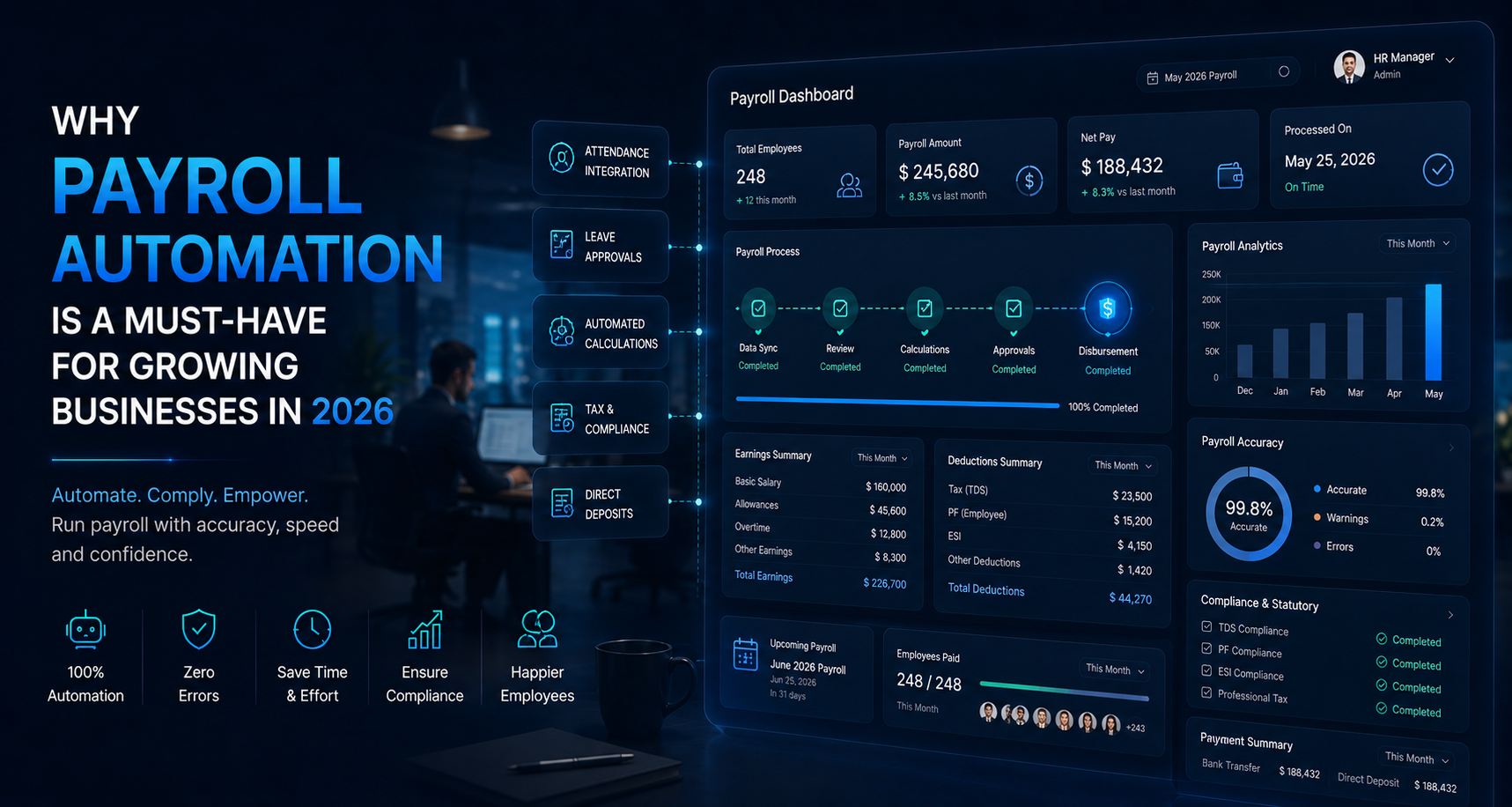
Why Payroll Automation Is a Must-Have for Growing Businesses in 2026
As businesses grow, payroll becomes more complex. What once worked with manual spreadsheets and basic calculations can quickly turn into a process filled with delays, errors, and compliance risks. In 2026, payroll automation is no longer just a convenience. It is a business necessity for companies that want to stay efficient, accurate, and scalable.
Modern payroll systems help businesses reduce repetitive work, improve accuracy, and connect payroll with attendance, leave, and employee data. This creates a smoother workflow for HR teams and gives leadership better visibility into salary-related operations.
The Hidden Cost of Manual Payroll Processing
Manual payroll may appear inexpensive at first, but it often creates hidden costs over time. HR teams spend valuable hours collecting attendance data, checking leave balances, validating salary components, and fixing mistakes before processing payroll.
These manual steps increase the chance of human error and can lead to employee dissatisfaction if salaries are delayed or calculated incorrectly. For growing businesses, this becomes a serious operational burden.
Common Payroll Challenges Growing Companies Face
As headcount increases, payroll teams often face new challenges such as:
- Tracking attendance accurately across teams
- Managing leave deductions and overtime
- Handling multiple salary structures
- Keeping payroll compliant with policies
- Reducing errors in salary processing
- Maintaining records for audits and reporting
Without automation, these challenges can slow down business operations and create avoidable stress for HR and finance teams.
How Payroll Automation Improves Accuracy and Compliance
Payroll automation reduces manual intervention and improves the consistency of every payroll cycle. When attendance, leave, and salary rules are connected in one system, calculations become faster and more reliable.
This also helps businesses maintain better compliance because the system can apply predefined rules consistently. Instead of manually checking every salary slip, HR teams can focus on exceptions, approvals, and strategic work.
The Connection Between Attendance, Leave, and Payroll
Payroll works best when it is connected to attendance and leave management. If these systems are separate, HR teams often need to reconcile data manually before running payroll. That slows down the process and increases the risk of mistakes.
When attendance and leave data flow directly into payroll, the process becomes seamless. Salary calculations reflect actual employee presence, approved leave, and overtime in a more structured way.
Benefits of Cloud-Based Payroll Systems
Cloud-based payroll systems give businesses more flexibility and control. HR teams can access payroll data from anywhere, manage approvals faster, and keep records centralized in one secure place.
Cloud payroll also supports scalability. Whether a business has 10 employees or 1,000 employees, the same system can continue to support the payroll process as the organization grows.
Final Thoughts
Payroll automation is not just about saving time. It is about building a more dependable HR operation. For growing businesses in 2026, automated payroll means fewer errors, stronger compliance, better efficiency, and a more professional employee experience.
Companies that invest in payroll automation today will be better prepared to grow with confidence tomorrow.
About the author
KianOps Editorial Team
Our team writes practical guides to help growing companies simplify HR operations, payroll, and admin workflows.
Ready to simplify HR?
See how KianOps can centralize HR operations for your team.