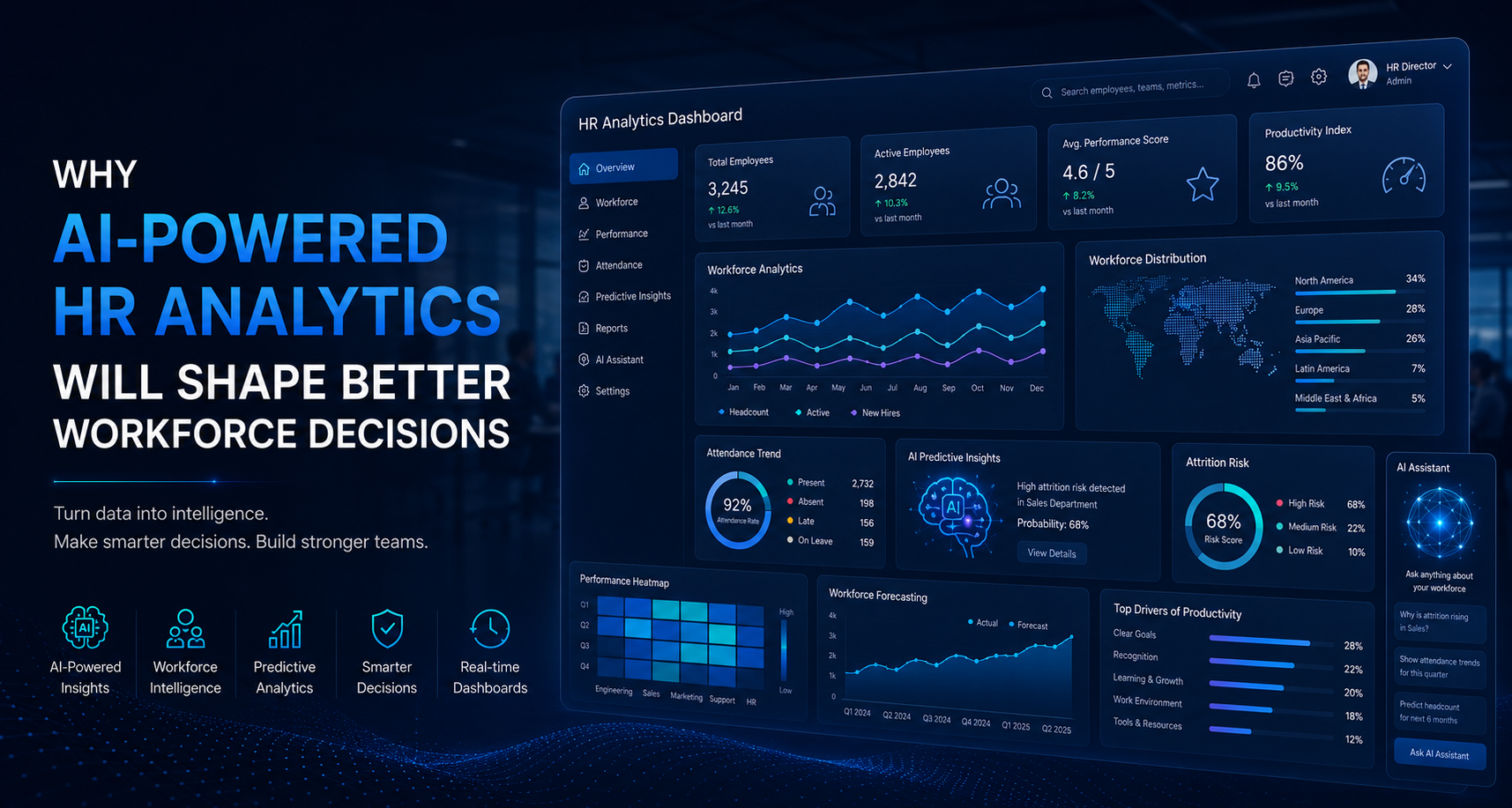
Why AI-Powered HR Analytics Will Shape Better Workforce Decisions
Businesses generate massive amounts of employee data every day through attendance systems, payroll processing, leave requests, project management, and performance tracking. However, collecting data alone is not enough. In 2026, successful organizations are using AI-powered HR analytics to transform workforce data into actionable business insights.
Modern HR leaders are moving away from reactive decision-making and adopting predictive analytics that helps identify trends, forecast workforce needs, and improve employee engagement before problems occur.
The Evolution of HR Analytics
HR analytics has evolved significantly over the last decade. Traditional HR reports focused primarily on historical data such as employee counts, attendance records, and payroll summaries.
Today's AI-powered analytics platforms provide real-time visibility into workforce performance, employee engagement, absenteeism trends, productivity patterns, and workforce planning opportunities.
Why Traditional HR Reporting Is No Longer Enough
Static reports often tell organizations what already happened. While useful, they do not help businesses understand what may happen next.
Modern organizations require deeper workforce intelligence to answer questions such as:
- Which teams have increasing absenteeism?
- Which employees may be at risk of leaving?
- Where are productivity bottlenecks occurring?
- How can workforce costs be optimized?
- Which departments require additional staffing?
AI-driven analytics helps answer these questions more effectively.
How AI Improves Workforce Visibility
Artificial intelligence enables organizations to analyze large datasets much faster than traditional reporting methods. AI can identify hidden patterns, detect anomalies, and highlight trends that may otherwise go unnoticed.
For HR teams, this means better visibility into attendance behavior, leave utilization, workforce productivity, overtime patterns, and employee engagement levels.
Predictive Analytics Is Transforming HR Decisions
One of the most valuable capabilities of AI-powered HR analytics is predictive decision-making.
Instead of simply reporting past events, predictive analytics can help organizations:
- Forecast staffing requirements
- Predict employee turnover risks
- Identify productivity challenges
- Improve workforce planning
- Support succession planning
- Optimize labor costs
This allows business leaders to make proactive decisions rather than reactive ones.
Connecting HR Data for Better Business Outcomes
The real value of HR analytics emerges when data from multiple systems is connected together.
Attendance records, leave management, payroll information, project tracking, and employee performance data create a complete workforce picture when analyzed collectively.
Integrated analytics provides leadership teams with accurate insights that support better operational and financial decisions.
What Businesses Should Focus on in 2026
Organizations looking to modernize HR operations should prioritize:
- Centralized workforce data
- Real-time analytics dashboards
- AI-powered reporting tools
- Predictive workforce planning
- Employee engagement insights
- Performance and productivity tracking
Companies that adopt data-driven HR strategies will gain a competitive advantage through better workforce visibility and smarter decision-making.
Final Thoughts
AI-powered HR analytics is becoming one of the most valuable capabilities within modern HR management systems. It enables organizations to move beyond basic reporting and unlock meaningful workforce intelligence.
As businesses continue to embrace digital transformation in 2026, AI-driven analytics will play a critical role in improving employee experience, increasing productivity, reducing operational risks, and supporting long-term business growth.
About the author
KianOps Editorial Team
Our team writes practical guides to help growing companies simplify HR operations, payroll, and admin workflows.
Ready to simplify HR?
See how KianOps can centralize HR operations for your team.