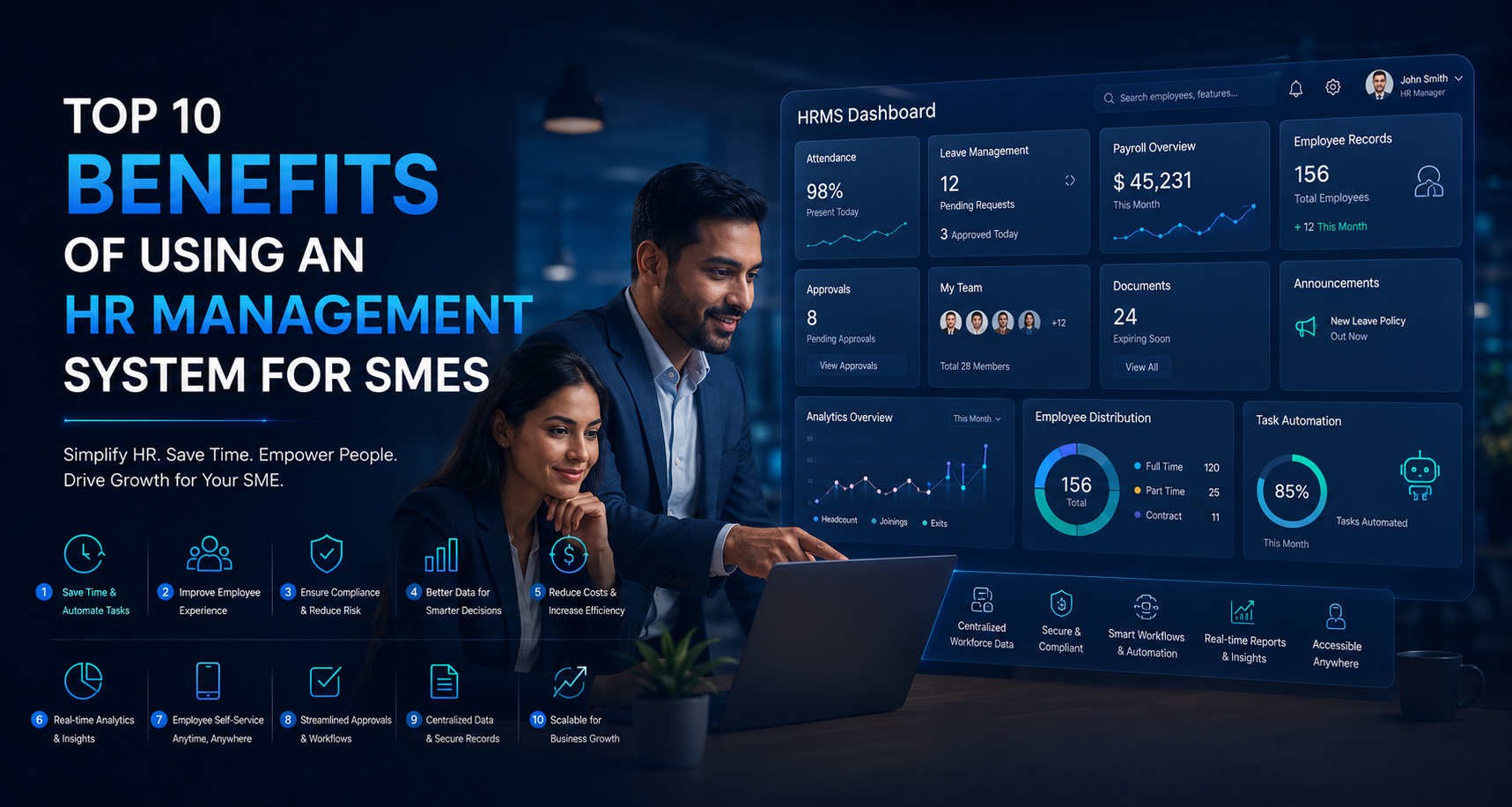
Top 10 Benefits of Using an HR Management System for SMEs
Small and medium-sized businesses often start with spreadsheets, emails, and manual follow-ups to manage HR operations. That approach works for a while, but as the team grows, the workload becomes harder to control. Modern HRMS platforms help SMEs centralize employee data, automate repetitive tasks, and improve visibility across attendance, payroll, leave, and employee records. Oracle describes HR software as a system used to manage employee data, payroll, recruitment, benefits, training, and attendance, while SHRM and Deloitte both emphasize the growing importance of automation, self-service, and faster adaptation in modern HR operations. :contentReference[oaicite:1]{index=1}
1. Centralize Employee Data in One Place
An HRMS gives SMEs one structured system for storing employee records, job details, documents, and attendance information. This reduces scattered files and improves data organization. Oracle notes that HR software improves employee data management and reduces the likelihood of error by keeping information organized in one system. :contentReference[oaicite:2]{index=2}
2. Automate Attendance, Leave, and Payroll Workflows
Automation saves time and reduces repetitive manual work. Instead of tracking attendance and leave in separate sheets, an HRMS can connect those workflows directly to payroll. SHRM’s current guidance highlights automation as a practical way to reduce administrative burden and improve HR efficiency. :contentReference[oaicite:3]{index=3}
3. Reduce Manual Errors
Manual processes increase the risk of mistakes in attendance, salary calculations, leave tracking, and employee records. With one system handling multiple functions, SMEs can improve accuracy and maintain cleaner records. Oracle explains that HR software helps decrease the likelihood of error while improving time efficiency. :contentReference[oaicite:4]{index=4}
4. Improve Employee Self-Service
Self-service is one of the strongest advantages of a modern HRMS. Employees can check attendance, apply for leave, view documents, and update basic information without depending on HR for every request. Gartner’s HR service management materials emphasize self-service access as a core feature, and SHRM notes that automation and self-service reduce HR dependency for routine work. :contentReference[oaicite:5]{index=5}
5. Strengthen Compliance and Process Consistency
For SMEs, compliance is easier when policies, approvals, and records are managed in one place. A structured HRMS helps businesses apply the same workflow every time, which improves consistency. Oracle and Gartner both describe centralized HR systems as useful for managing workforce information and maintaining organized processes. :contentReference[oaicite:6]{index=6}
6. Scale Faster Without Scaling HR Headcount
As SMEs grow, HR work grows too. An HRMS helps the business handle more employees without adding as much manual admin work. Gartner’s peer insights and Oracle’s HRMS descriptions both point to automation and centralized workflow management as key ways to improve workforce productivity and efficiency. :contentReference[oaicite:7]{index=7}
7. Make Better Decisions with Real-Time HR Data
HRMS platforms give owners and managers a clearer view of attendance patterns, leave usage, payroll inputs, and workforce status. Deloitte’s 2026 research shows that speed, adaptability, and better orchestration of people and resources are now major leadership priorities, which makes real-time HR visibility especially valuable. :contentReference[oaicite:8]{index=8}
8. Improve Onboarding and Employee Experience
A better HR system makes onboarding smoother and daily employee interactions easier. New joiners can access information faster, and existing employees can manage routine requests without friction. Oracle and Gartner both describe HR software as a way to support the employee lifecycle through centralized access and streamlined processes. :contentReference[oaicite:9]{index=9}
9. Save Time Across HR Operations
Time savings are one of the biggest reasons SMEs adopt HRMS software. HR teams spend less time chasing records, correcting entries, and answering repetitive questions. SHRM’s current guidance on automation makes clear that modern HR teams are using technology to free up time for more strategic work. :contentReference[oaicite:10]{index=10}
10. Control Costs More Effectively
When HR work is automated and standardized, businesses can control operational costs more effectively. An HRMS reduces the need for fragmented tools, manual follow-ups, and duplicate effort. Deloitte’s 2026 trends report underscores that organizations are focusing on speed and resource orchestration, which ties directly to cost discipline and smarter operations. :contentReference[oaicite:11]{index=11}
Final Thoughts
For SMEs, an HR management system is not just a software upgrade. It is an operational advantage. It helps teams centralize data, automate repetitive work, improve employee experience, and support better business decisions. In 2026, the companies that adopt HRMS early will be better positioned to grow with control, clarity, and speed. :contentReference[oaicite:12]{index=12}
About the author
KianOps Editorial Team
Our team writes practical guides to help growing companies simplify HR operations, payroll, and admin workflows.
Ready to simplify HR?
See how KianOps can centralize HR operations for your team.