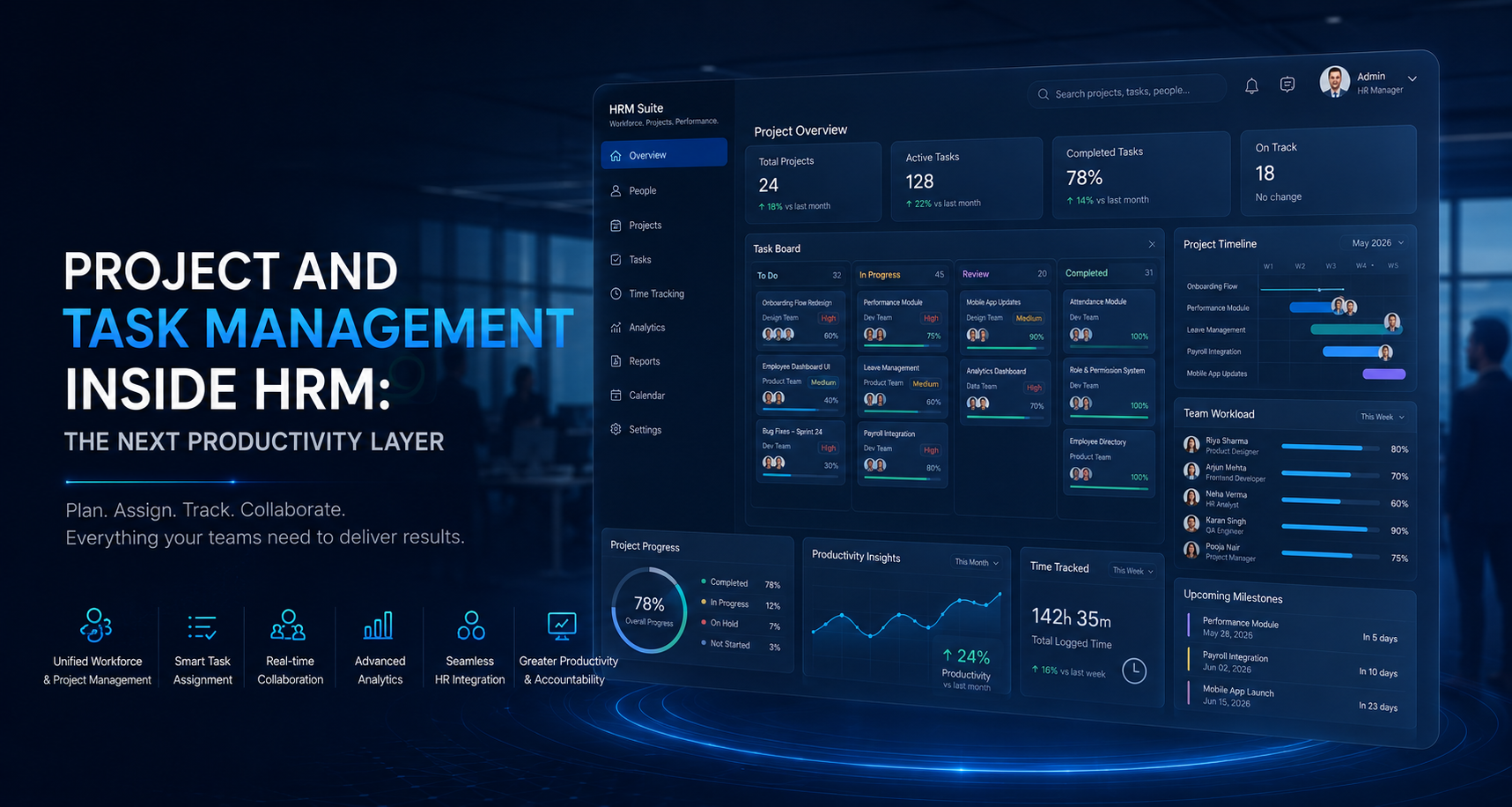
Project and Task Management Inside HRM: The Next Productivity Layer
For years, HR systems focused mainly on attendance, leave, payroll, and employee records. While these functions remain important, modern organizations now need more visibility into how employees contribute to business outcomes. This is why project and task management is becoming an essential layer inside modern HRM platforms.
Why Traditional HR Systems Are No Longer Enough
Businesses today operate in a fast-paced environment where employee productivity directly impacts growth. Managing attendance and payroll alone does not provide enough insight into workforce performance. Companies need visibility into project progress, task completion, team workloads, and employee accountability.
Modern HRM systems are evolving to bridge the gap between employee management and operational execution.
The Connection Between Employees, Projects, and Productivity
Employees are assigned tasks. Tasks contribute to projects. Projects drive business results. When these three elements exist in separate systems, managers lose visibility and teams become less efficient.
An integrated HRM platform allows businesses to connect employees directly with projects and tasks, creating a unified workflow that improves transparency and performance tracking.
How Integrated Task Management Improves Accountability
One of the biggest challenges for growing businesses is accountability. Managers often struggle to understand who is working on what, what has been completed, and where delays are occurring.
Integrated task management helps solve this challenge by providing:
- Task assignment tracking
- Status monitoring
- Deadline management
- Employee workload visibility
- Project progress reporting
This creates a culture of ownership and improves team efficiency.
Real-Time Project Visibility Helps Management Make Better Decisions
Business leaders need real-time insights. Instead of waiting for weekly reports or status meetings, managers can view project progress instantly through dashboards and reports.
This visibility helps organizations identify bottlenecks early, allocate resources effectively, and improve delivery timelines.
Why Businesses Are Moving Away from Multiple Tools
Many companies use separate tools for HR, attendance, payroll, project management, and task tracking. While this works initially, it often creates data silos, duplicate entries, and unnecessary operational complexity.
An all-in-one HRM platform reduces tool switching, improves collaboration, and centralizes workforce data in one location.
What Companies Should Look for in an Integrated HRM Platform
When evaluating modern HRM software, businesses should look for:
- Employee management
- Attendance and leave tracking
- Payroll automation
- Project management
- Task assignment and tracking
- Performance visibility
- Reporting and analytics
The goal is to create a connected operational ecosystem rather than managing multiple disconnected systems.
Final Thoughts
Project and task management is quickly becoming the next productivity layer in modern HRM systems. Businesses that combine workforce management with project execution gain better visibility, stronger accountability, and improved operational efficiency.
As organizations continue to scale in 2026 and beyond, integrated HRM platforms will play a critical role in driving productivity and business growth.
About the author
KianOps Editorial Team
Our team writes practical guides to help growing companies simplify HR operations, payroll, and admin workflows.
Ready to simplify HR?
See how KianOps can centralize HR operations for your team.