HRMS vs Traditional HR Management: Which Is Better for Growing Companies?
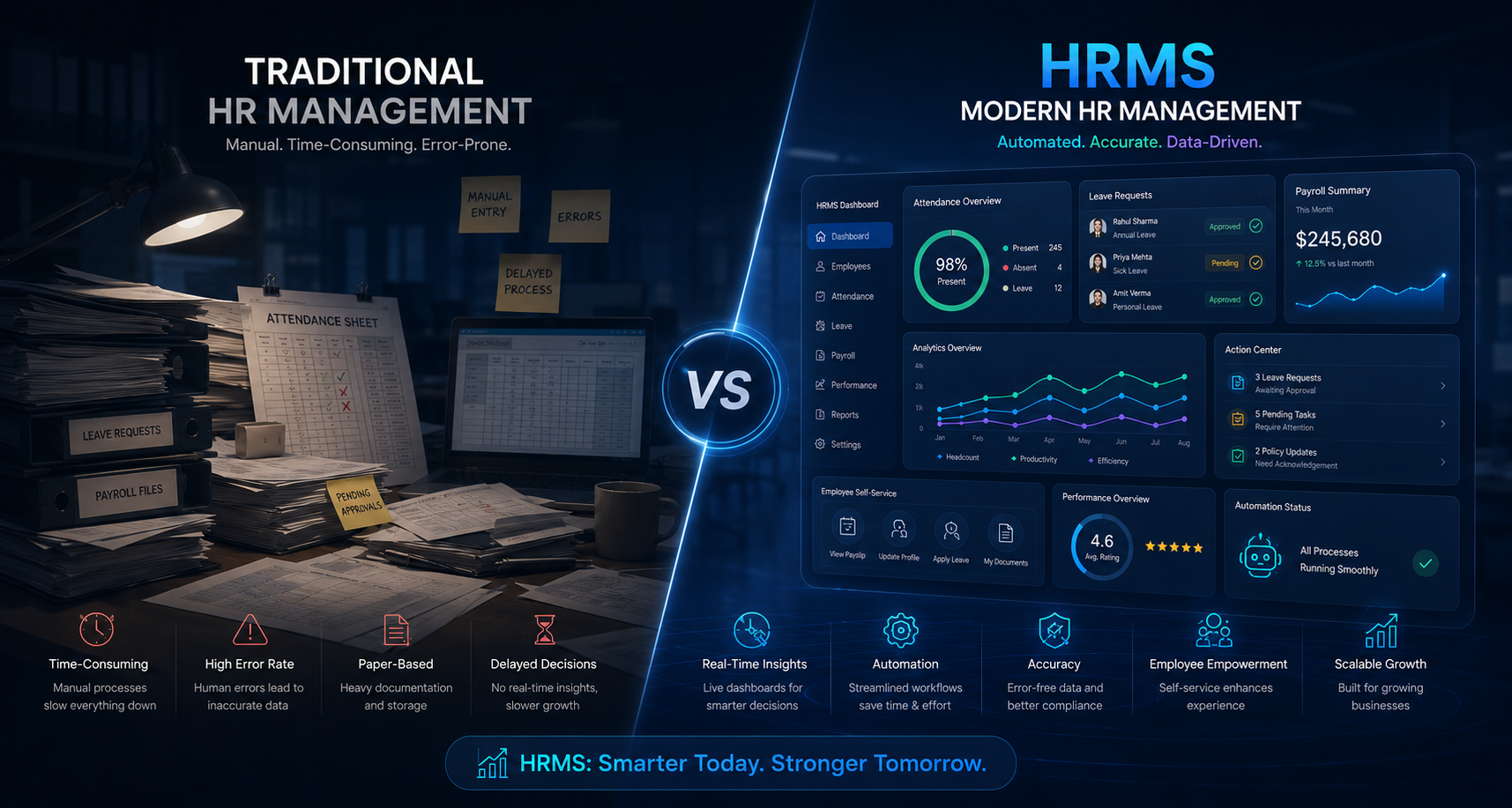
As companies grow, the way they manage people has to grow with them. Traditional HR management can work in the early stage, but once attendance, payroll, leave, compliance, and reporting start increasing, manual processes begin to slow everything down. Current HR research from SHRM shows that automation and self-service reduce administrative burden, while modern HRMS platforms are increasingly treated as strategic enablers rather than standalone tools. :contentReference[oaicite:1]{index=1}
What Traditional HR Management Looks Like
Traditional HR management usually depends on spreadsheets, email threads, paper files, and repeated manual follow-ups. HR teams often spend time collecting attendance data, checking leave requests, updating payroll inputs, and answering employee questions one by one. Oracle describes HR as responsible for employee-related concerns such as payroll, compliance, benefits administration, onboarding, and day-to-day employee issues, which makes it clear why manual handling becomes heavy as the business expands. :contentReference[oaicite:2]{index=2}
Why Growing Companies Outgrow Manual HR Processes
Manual HR operations may feel manageable at first, but they become harder to control as the team grows. More employees mean more requests, more payroll changes, more compliance checks, and more reporting pressure. SHRM notes that automation helps HR teams respond faster and reduces dependence on staff for standard administrative work, which is exactly where traditional HR begins to break down. :contentReference[oaicite:3]{index=3}
How HRMS Improves Speed, Accuracy, and Visibility
An HRMS centralizes employee data, attendance, leave, payroll, and approvals in one place. That means fewer duplicate entries, fewer human errors, and faster processing. SHRM’s 2026 research also shows HR professionals want to automate routine, repetitive, and transactional tasks through self-service platforms, chatbots, and workflow tools to improve productivity and employee experience. :contentReference[oaicite:4]{index=4}
Employee Self-Service and Automation Make the Difference
One of the biggest advantages of HRMS is employee self-service. Instead of depending on HR for every small request, employees can manage attendance, leave, documents, and routine updates themselves. SHRM explicitly states that self-service options reduce dependence on HR staff for administrative needs, while automation improves efficiency, accuracy, and responsiveness in HR operations. :contentReference[oaicite:5]{index=5}
Which Model Works Best as the Team Scales?
For very small teams, traditional HR methods can work in the short term. But for growing companies, HRMS is the stronger long-term model because it reduces workload, improves consistency, and supports better decision-making. Deloitte and SHRM both point toward technology-enabled HR operations, faster workflows, and stronger employee experience as key priorities for modern organizations. :contentReference[oaicite:6]{index=6}
Final Thoughts
If a company is planning to scale, HRMS is usually the better choice. Traditional HR management is simple at the start, but it becomes inefficient as complexity rises. HRMS gives growing companies the structure, speed, and visibility they need to run HR as a business function rather than a manual support task.
About the author
KianOps Editorial Team
Our team writes practical guides to help growing companies simplify HR operations, payroll, and admin workflows.
Ready to simplify HR?
See how KianOps can centralize HR operations for your team.