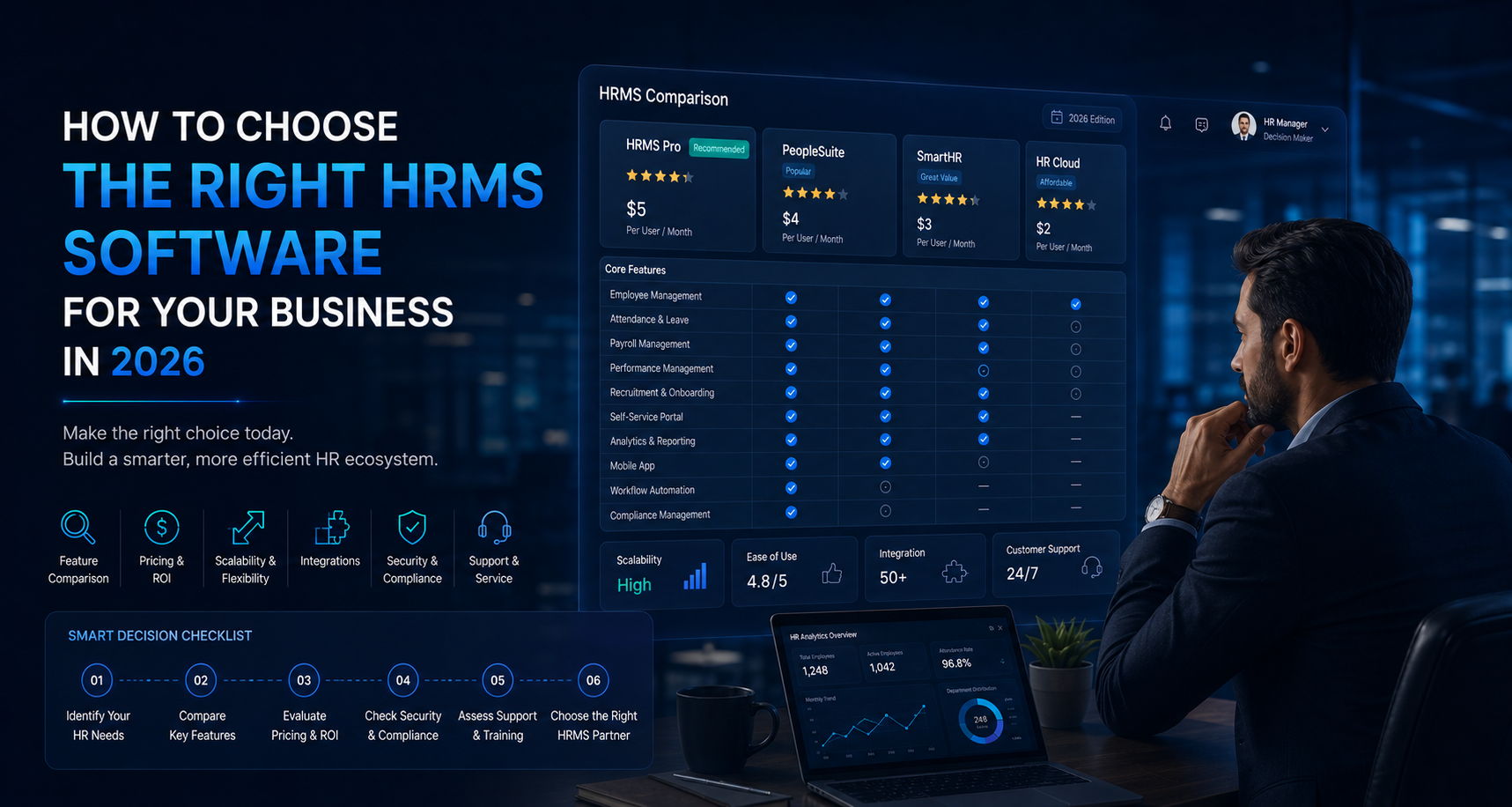
How to Choose the Right HRMS Software for Your Business in 2026
Choosing HRMS software is no longer just a technical purchase. In 2026, it is a strategic business decision that affects payroll accuracy, employee experience, manager efficiency, and long-term scalability. SHRM’s buyer guidance says the right purchase decision depends on identifying the right features, understanding the benefits, reviewing pricing, and evaluating other key considerations before buying. Oracle also describes HRMS as a unified system for managing employee data, payroll, attendance, recruitment, benefits, training, and engagement. :contentReference[oaicite:1]{index=1}
Start With Your Business Needs
The first step is to define what your company actually needs from the system. A small team may only need attendance, leave, payroll, and employee records, while a growing business may also need project tracking, reporting, approvals, and multi-company support. SHRM’s HR software buying guide recommends starting with requirements before comparing products, because the best system is the one that matches your workflow rather than one with the longest feature list. :contentReference[oaicite:2]{index=2}
Identify the Core HRMS Features You Actually Need
A strong HRMS should cover the essentials first: employee data, payroll, attendance, leave, self-service, and reporting. Oracle’s HRMS and HCM materials show that modern HR software commonly supports employee data management, payroll, attendance, benefits, recruitment, and the complete employee experience. For many businesses, these core modules are enough to replace spreadsheets and disconnected tools. :contentReference[oaicite:3]{index=3}
Check Integration and Scalability Before You Buy
As a business grows, HR software should connect cleanly with finance, attendance tools, project systems, and other operational workflows. Oracle positions its HR platform as a single common data source with configurable workflows and scalability, which highlights how important connected systems are for growing organizations. SHRM also advises comparing what already exists in your HR ecosystem with standalone point solutions before making a final decision. :contentReference[oaicite:4]{index=4}
Evaluate User Experience and Employee Self-Service
Good HRMS software should make life easier for both HR teams and employees. Self-service reduces dependency on manual HR follow-ups and gives employees faster access to the information they need. Oracle’s HRMS materials include self-service human resources as part of the integrated suite, and SHRM’s current HR guidance highlights automation and self-service as practical ways to reduce administrative burden while improving the employee experience. :contentReference[oaicite:5]{index=5}
Review Security, Support, and Implementation Quality
HR data is sensitive, so security and implementation matter just as much as features. Your vendor should be able to explain how data is protected, how permissions work, and how support is handled after go-live. SHRM’s selection guidance emphasizes that HR technology evaluation is not only about software capability but also about the full buying and adoption process, including implementation considerations. :contentReference[oaicite:6]{index=6}
Compare Pricing, Contracts, and Hidden Costs
Pricing should be evaluated as a full business cost, not just a monthly subscription number. SHRM’s 2026 pricing guidance warns that pricing models and hidden fees can vary widely, so buyers should review onboarding, support, setup, add-ons, and future scale costs before deciding. This is especially important for SMEs that need predictable costs as they grow. :contentReference[oaicite:7]{index=7}
Final Thoughts
The right HRMS software in 2026 is the one that fits your business stage, reduces manual work, supports employee self-service, scales with your growth, and keeps costs predictable. If you choose based on real workflow needs instead of just feature lists, you will end up with a system that supports operations instead of creating more complexity. :contentReference[oaicite:8]{index=8}
About the author
KianOps Editorial Team
Our team writes practical guides to help growing companies simplify HR operations, payroll, and admin workflows.
Ready to simplify HR?
See how KianOps can centralize HR operations for your team.