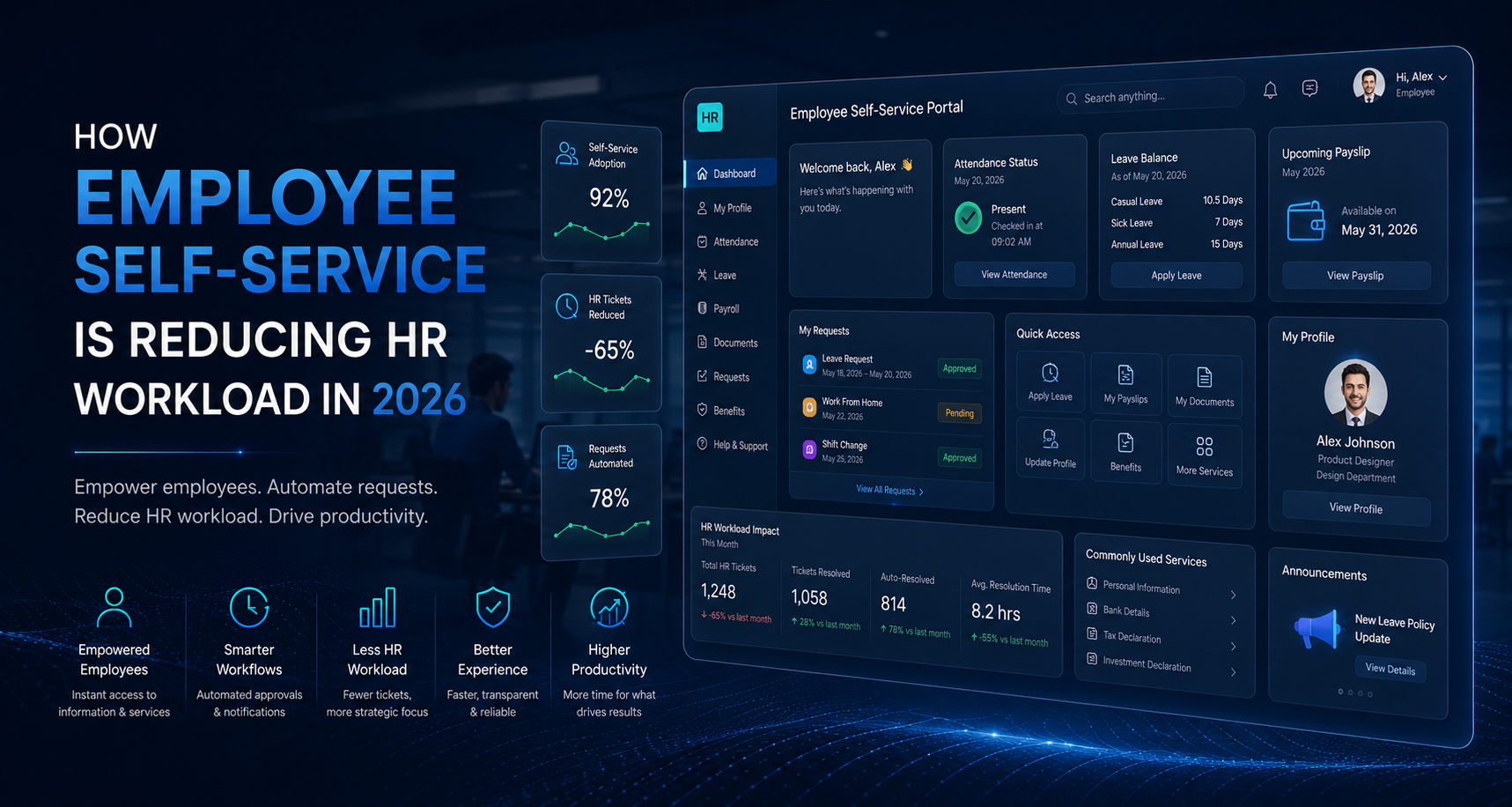
How Employee Self-Service Is Reducing HR Workload in 2026
Employee self-service has become one of the most practical upgrades in modern HR software. Instead of relying on HR teams for every small request, employees can now handle routine actions through a portal or dashboard. In 2026, this shift is closely aligned with HR priorities around AI-driven transformation, automation, and improved employee experience. turn252866search2 turn252866search4 turn252866search19
Why Employee Self-Service Matters More Than Ever
Businesses are under pressure to move faster while keeping HR operations simple and scalable. Self-service helps by giving employees direct access to their own data, requests, and records. This reduces dependency on HR teams and creates a smoother day-to-day workflow for everyone involved. Gartner’s 2026 HR priorities and Deloitte’s HR transformation insights both point toward centralized, AI-enabled, and more efficient employee experiences. turn252866search4 turn252866search11 turn252866search20
How Self-Service Reduces HR Support Tickets
Many HR teams spend valuable time answering repetitive questions about attendance, leave balances, pay slips, approvals, and employee records. A self-service portal reduces this pressure by letting employees find the information they need without waiting for manual support. Deloitte highlights that intuitive employee portals and self-service capabilities can reduce HR workload while improving access and standardization. turn252866search2 turn252866search11
The Role of Automation in Faster HR Operations
Self-service works best when paired with automation. For example, an employee can submit a leave request, a manager can approve it, and the system can update HR and payroll data automatically. SHRM notes that automation is reshaping routine work and helping organizations reduce repetitive admin tasks, while AI is increasingly being used to support HR workflows. turn252866search3 turn252866search9
Better Employee Experience Starts With Access and Visibility
Modern employees expect easy access to their information. A good self-service system gives them visibility into attendance, leave, salary-related records, and workflow status in one place. Gartner’s integrated HR service management materials emphasize self-service access and a single organized environment for HR information, which helps improve consistency and reduce friction. turn252866search10 turn252866search4
Why Self-Service and HR Data Should Stay Connected
Self-service becomes far more powerful when it connects to attendance, payroll, and HR records. This creates one system of truth and reduces duplicate work. When employees update information themselves and the system syncs that data across workflows, HR teams gain speed, accuracy, and better control over operations. Deloitte and Gartner both point to connected platforms as a major part of modern HR transformation. turn252866search2 turn252866search20 turn252866search19
Final Thoughts
Employee self-service is no longer a secondary feature. In 2026, it is a strategic capability that helps companies reduce HR workload, improve efficiency, and deliver a better employee experience. Businesses that invest in self-service now are building a more scalable HR foundation for the future.
About the author
KianOps Editorial Team
Our team writes practical guides to help growing companies simplify HR operations, payroll, and admin workflows.
Ready to simplify HR?
See how KianOps can centralize HR operations for your team.